Give your n8n workflows eyes on the web
The automation platform your team already runs can now act on genuinely new content from anywhere on the web. Meet the official Hypeline node for n8n.
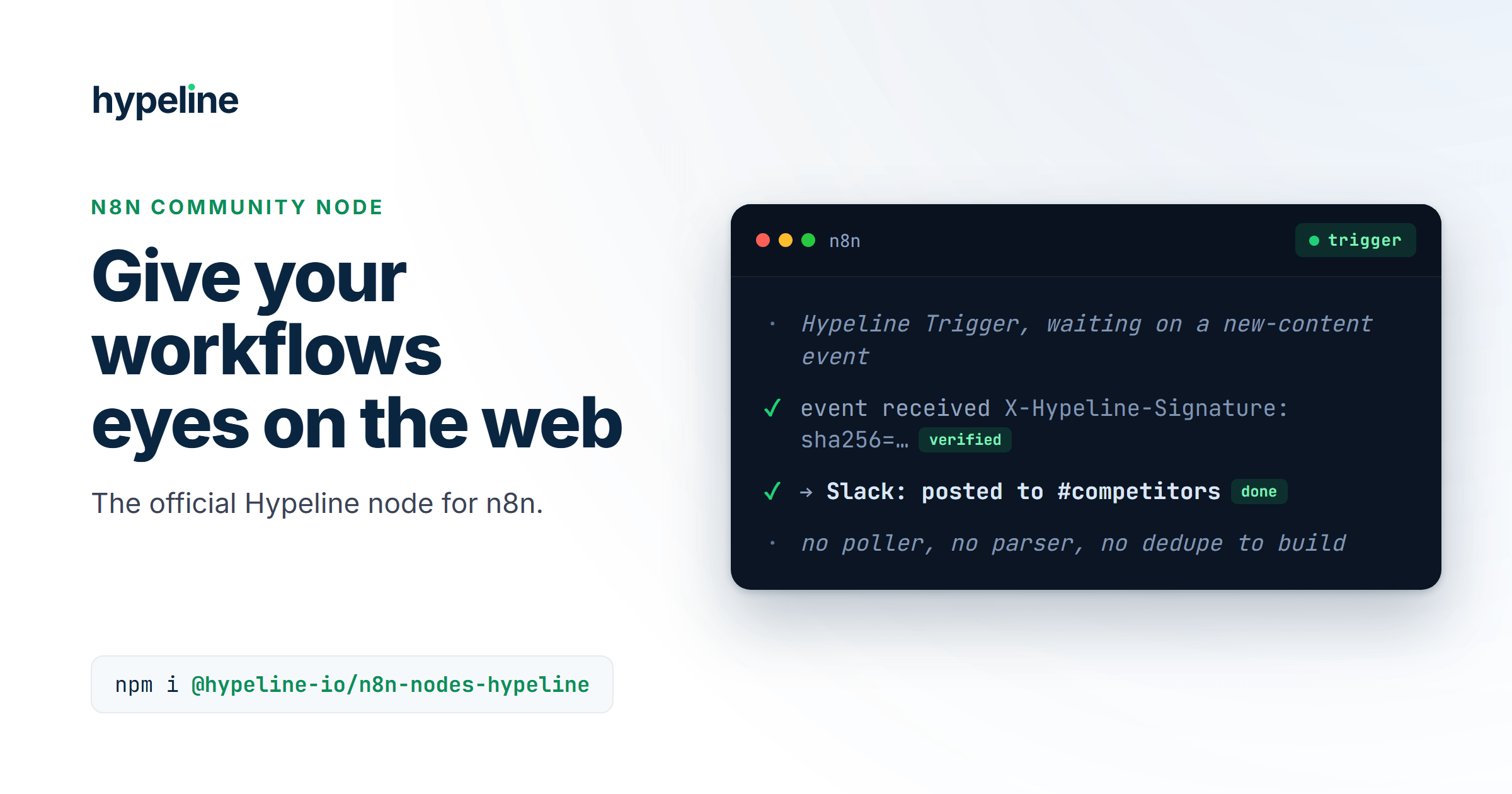
Most automations have a blind spot. They can transform, route, and deliver data beautifully, but they wait for someone, or something, to hand them a clean signal that a web page actually changed. Building that signal yourself means a poller, a parser, change detection, deduplication, retries, and delivery, rebuilt for every new source.
@hypeline-io/n8n-nodes-hypeline removes that work. Point Hypeline at any feed, streaming source, or web page, and it turns that URL into one deduplicated event stream of real changes. This node brings that stream inside n8n, so a workflow (or an agent driving n8n) can start on a change and manage the monitoring itself.
What it does
The package ships two nodes and a credential:
- Hypeline Trigger. Activate a workflow and the trigger registers a webhook destination for you, then fires the workflow on each new-content event. On deactivation it removes what it created, and nothing else.
- Hypeline. An action node for managing monitoring from inside a flow: create, list, update, and delete sources, alerts, and delivery destinations over the public REST API.
- Hypeline API credential. A
hype_bearer key with a live test button, so you know it authenticates before you build.
Signed, and verified before your workflow runs
Every delivery carries an HMAC signature over the exact bytes we sent, with a timestamp. The Trigger verifies that signature on the raw body before the workflow runs. A tampered or replayed request never fires your flow, so you can act on an event without trusting the network it arrived over.
Zero runtime dependencies
The node has an empty dependency tree. The signature check is implemented with Node's built-in node:crypto, not a third-party library, and everything else it needs at runtime comes from n8n. That keeps the install small, the supply chain tiny, and the package inside n8n's strict verification bar. Even the tests use the built-in node:test runner.
Install
In n8n, open Settings › Community Nodes, choose Install, and enter:
@hypeline-io/n8n-nodes-hypelineThen create a Hypeline API credential with a hype_ key from your Hypeline account (Settings › API keys) and click Test.
A quick example
Say you want to know the moment a competitor changes their pricing page:
- Add a Hypeline Trigger node and choose Create New.
- Give it a query, for example
pricing OR "price change", optionally scoped to specific sources. - Add the page as a source (from the same workflow, or once in the Hypeline node), then activate the workflow.
From then on, the workflow does nothing on a timer. When the page genuinely changes, the event arrives, verified, and your next step runs: post to Slack, open a ticket, update a sheet, whatever the flow already does. No duplicate firings on the same edit.
Built for agents too
The same public API sits behind an MCP server, so an agent working in n8n can add sources, set alerts, and read the event stream as tools. Give your agents a standing watch they set once, and they spend tokens on the change, not on checking.
The node is open source (MIT) and lives at Hypeline-io/n8n-nodes-hypeline. Grab it on npm, read the docs, and tell us what you build.
Want the step-by-step version? The guide to monitoring web changes with n8n walks through a full workflow, and verifying a webhook signature covers the HMAC check the Trigger performs for you. If you would rather start from a ready-made set of sources, browse the use cases.